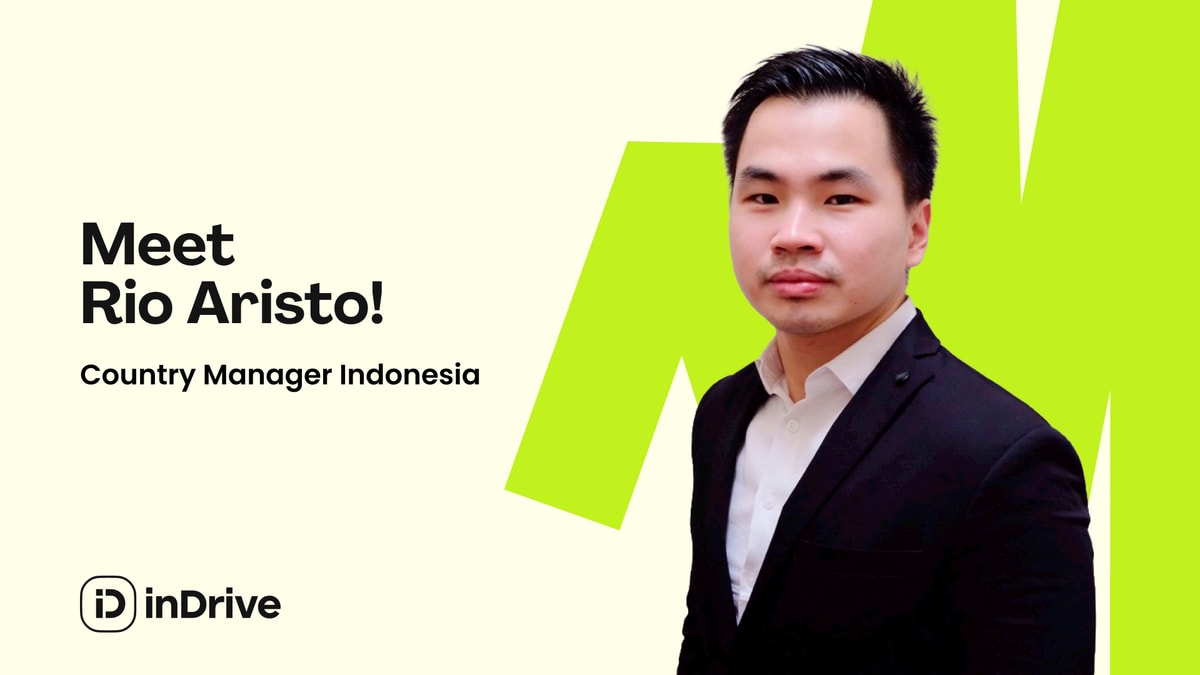
Rio Aristo took on the role of inDrive’s Country Manager for Indonesia in late 2025. We asked him for his insights into the local ride-hailing market: where it’s going, what it needs, and what inDrive is doing differently. We also asked a few questions about his personal story – here’s what he had to say.
Indonesia is a complex mobility market, with hundreds of cities spread across multiple islands, each requiring a localized approach. The market combines high price sensitivity with frequent daily usage, where ride-hailing serves both as a necessity and convenience.
Ride-hailing services contribute to solving urban transportation challenges by bridging first-mile, mid-mile, and last-mile gaps connecting users to public transport, while also providing reliable options in areas where infrastructure is limited or inconsistent.
What’s the biggest development on the horizon for ride-hailing in Indonesia? Although Indonesia is historically a price-sensitive market, as the market matures, there’s increasing demand for higher-quality cars in premium tiers, especially from mid- to high-income segments, corporate users, and families who prioritize comfort, reliability, and overall experience.
Also a deeper integration into SuperApps, led by the incumbent players. Ride-hailing is part of a broader ecosystem including food delivery, groceries, payments, and financial services with intention to increase user stickiness.
Another important development lies in the continued growth of cashless adoption. As more users shift to digital payments, it improves transaction efficiency, reduces friction, and enables better integration with broader ecosystems—ultimately unlocking higher frequency of use and new monetization for platforms.
I’m particularly excited about how AI is reshaping the ride-hailing experience by improving matching between drivers and passengers, predicting demand more accurately, better routing, and supporting drivers with better insights on where and when to operate.
What new technologies or product features do you think urban mobility needs? Smarter matching and routing to reduce wait times and congestion, more transparent pricing models so users and drivers clearly understand fares, and better tools to support driver earnings and flexibility. It also requires deeper integration with public transport and digital payments, so mobility becomes a seamless end-to-end journey rather than a standalone service.
inDrive offers a fundamentally different approach to the two major incumbent players. It’s built on freedom of choice, where drivers and passengers directly negotiate and agree on fares, creating a more transparent, flexible, and human-centered experience for both sides.
Since taking on the role of country manager, I’ve been surprised by how strongly both drivers and passengers resonate with the idea of fairness and choice. In a market long shaped by algorithm-driven platforms, I expected some hesitation—but instead, many users immediately understand and appreciate the ability to negotiate and agree on prices themselves. Beyond price and convenience, there is a real demand for a more transparent and human approach to mobility.
What do you most hope to achieve as Country Manager? To build inDrive into a trusted and sustainable mobility platform in Indonesia, where both drivers and passengers feel the system is fair and works in their favor. Beyond growth, the goal is to establish a strong local business that delivers consistent value without relying on unsustainable practices, while setting a new standard for transparency and balance in the industry.
How do your previous roles and experience support you in this role? Having the experience managing end-to-end P&L across multiple business units, managing multiple teams from various departments, and balancing growth with operational efficiency helped me understand how to operate in highly competitive and price-sensitive markets.
A book I think everyone should read: Radical Candor by Kim Scott. It captures a simple but powerful idea: the best leaders are those who care personally while challenging directly
A film I think everyone should watch: 300 (The Spartans movie by director Zack Snyder) because it’s a powerful story about leadership, conviction, and standing firm in the face of overwhelming odds. It highlights how a small, disciplined group with a clear purpose can challenge a much larger force—not just through strength, but through unity, strategy, and belief. It’s a reminder that in any competitive environment, clarity of mission and strong leadership can make a powerful impact.
One of my greatest achievements outside of work was becoming a certified instructor in BodyPump by Les Mills and TRX program, and actively teaching classes for seven years at a prominent gym in Indonesia. It was more than just fitness—it was about building discipline, connecting with people, and helping others push their limits. Leading classes and new program launches also strengthened my confidence and ability to engage and motivate a diverse group, which continues to be valuable in my professional leadership role today.