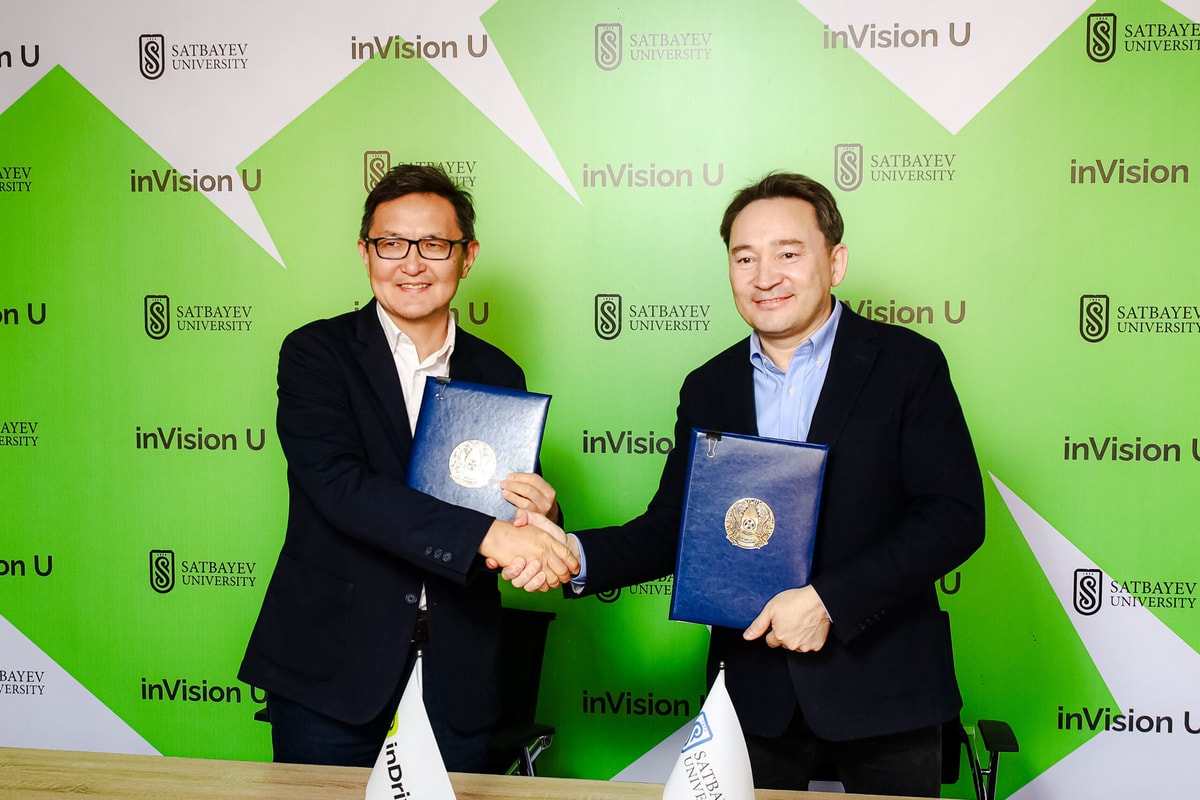
inDrive and Satbayev University (Almaty, Kazakhstan) have officially signed a partnership to launch inVision U, a new faculty, dedicated to shaping the future leaders and entrepreneurs.
Following up with Andrew Wachtel
In July 2023 we first spoke to Andrew Wachtel, inVision’s Director of Education, about the creation of a new and unusual kind of university, as envisioned by our CEO, Arsen Tomsky. With inDrive and Satbayev University (Almaty, Kazakhstan) recently signing a partnership to launch inVision U, a new faculty dedicated to shaping future leaders and entrepreneurs, we thought it was time for an update. Here’s what Andrew had to say about how the partnership with Satbayev will work, and the next big challenges facing the project.
Signing with Satbayev:
The original idea was that we would do this all on our own, but as we started looking at the various requirements, there were two main drawbacks. One was financial: in order to start on our own university, we needed to buy a building – that's required by law in Kazakhstan under normal circumstances. And Arsen wasn't really interested in buying a building at this point.
And then, as we wanted to start an engineering program, there was always this question of how to create the laboratory space, and how would we choose only one branch of engineering to be the right one for us… we wouldn't be able to open a very wide variety of programs.
This way of doing things – working inside a larger university – was done in Russia by colleagues of mine. They opened a faculty inside St. Petersburg State University and it existed for many years quite happily, until politics intervened. But this approach allows you to have the best of both worlds: You get to use the infrastructure of a much larger university, but you get your own autonomous programs inside there.
And then, especially for things like engineering, you can take advantage of their laboratories; put your students in various departments and then bring them together for your own seminars – but they can get the bulk of their training in existing engineering programs. So it seemed like a pretty good way of doing this.
We talked to a number of potential partners, but Satbayev was our preferred partner because they're the best engineering school in the country.
So we have five major departments, and three of them will be completely our own: media production and marketing, sociology and public policy. [Satbayev] doesn't have any programs in these domains. They're actually interested in creating a couple of programs of their own in these areas, so they're happy that we're doing this, because we get a license to operate and then they can use the license. We want to make sure they get something out of this partnership, too, other than just us paying them.
The program that we're doing is basically an IT development and design program. Satbayev has a ton of IT programs, as you might expect from an engineering school, though they don't have any excess capacity... so we would be hiring our own faculty.
Officially our program would be living inside one of their IT departments, but again, they would pretty much not touch it. We want to develop people who are going to create their own IT products. [Satbayev] is more inclined to create solid IT professionals; we're a little bit more on the entrepreneurial side.
Our engineering [program] is the most complicated part of the program. We will accept our own engineering students, but they can go to whatever engineering department they want. There are quite a lot of departments in Satbayev, so if some of our students want to do electrical engineering or robotics, and others want to do environmental engineering, that's fine.
In the first year program, they do the social sciences and humanities part with us, and the math and science – which are requirements for an engineering program – they do with Satbayev. In the second and third year, which are the bulk of the major program, 80% of the courses they'll take in the major that the department offers, and we will offer one seminar each semester … to get them out of the narrow engineering mindset.
For example, we'll teach a compulsory seminar in the second year called “what could possibly go wrong?” It's essentially about how seemingly good engineering solutions sometimes lead to disastrous results, and how to think about what's a good solution and what's not … So the engineering department teaches them how to make a robot, and we want them to think about what happens when the robot goes off the campus and starts killing people.
Then, in Kazakhstan, students in the final year have to defend their diploma project in their own department. So that means essentially [our students] carve out the part they did of the project, and present it for their diploma work. And then for us, they present the project as a team.
The question was how to create programs [that develop problem-focused entrepreneurs] but also create people who were competent and qualified to do something. It's great to say all the students will come out as part of these teams that come up with brilliant inventions that will change the world, but the vast majority of students … will have to go on and do something else. We can't only train them to work in a team and create a company based on their project. If we do that, most will fail and then they'll turn to us three years later and say, what did you give me?
So within this framework, we have to be able to train people to work in teams and create unique projects, but also to have enough background in their major area that if they want to go on and do a master's degree or a PhD in that field or get a job, they can.
What are the most immediate challenges? There are immediate, boring challenges associated with getting this program approved by the Kazakh Ministry of Education, which is required of course and takes a lot of time and effort. But the most important thing is finding local faculty that's strong enough or who we can train to teach the way we want it done. Finding the person to run the engineering program – that is probably going to be the key position … is going to be a challenge.
And then the next challenge will be finding really interesting, good students from disadvantaged or rural backgrounds whose parents are going to be willing to let them do this.
The goal is to have 25-30 students start our foundation year this summer, which is an extra year for those students who come from disadvantaged backgrounds to get up to speed. Then we'll try to add around 75 students so that we have about 100 students starting our undergraduate programs in the fall of 2026.