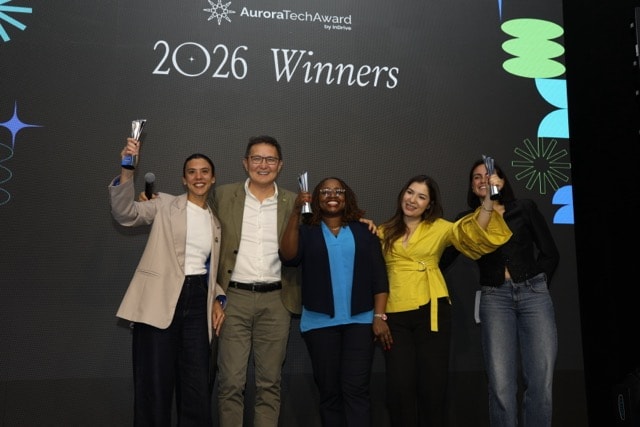
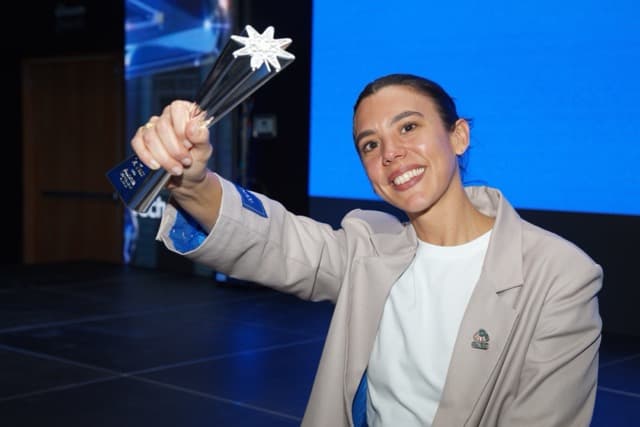
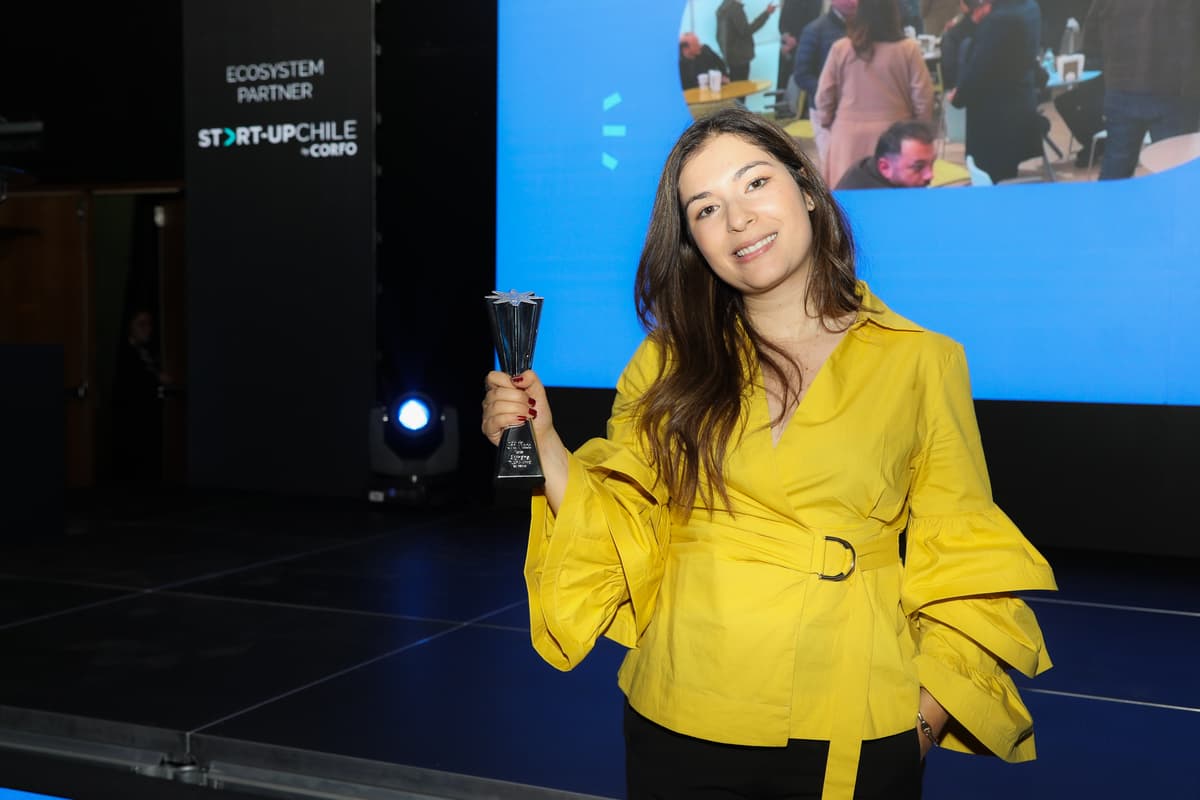
On May 8th in Santiago de Chile, Mercedes Bidart, founder of Quipu (Colombia) – a startup that helps informal workers access capital by building an alternative credit scoring system – was named the winner of this year’s Aurora Tech Awards, receiving $50,000 USD to scale her global impact. Second place went to Penny Musengi (Kenya) and her startup Pesira, and third place to Estefanía Abello (Colombia) and Muta. Congratulations to the winners – it’s a huge achievement, especially as this year’s edition received a record 3,400 entries.
In the lead-up to the award ceremony, the Aurora team announced the launch of Aurora Ventures. This will invest in women founders in emerging markets, using inaugural backing from inDrive. Clearly, it’s been a transformative year for the Aurora project. Isabella Ghassemi-Smith, the head of Aurora, told us how — and why – the project is evolving:
In 2025, all-women founding teams accounted for 5.6% of global VC deals in 2025, yet received just 1.4% of total VC funding. Powered by inDrive, the Aurora Tech Award was founded to address this gender funding gap. It started out as an award to platform those who were not getting platformed – to grow their access to investment through visibility and connections, and so help bridge the funding gap. It’s grown into one of the world’s largest pipelines of early-stage women founders outside traditional venture networks.
Over the past year, my team’s main goal has been to increase the legitimacy and scale of the award. We took a twofold approach: First, bringing in standard market metrics with which to assess entrants, so that when we say “the top 10 companies”, the rest of the market trusts the due diligence done to select these companies. Because for us, success is other investors investing in the companies that we platform.
Second, we set out to increase the market’s awareness of the award, along with inbound applications. We’ve done this by doubling down on the brand and marketing, as well as increasing our referrals, using our partner networks. This has taken us from 2018 applications from 116 countries last year to 3,400 from 127 countries this year; our social media has grown sixfold on Instagram and more than tripled on LinkedIn.

We’ve confirmed that the ecosystem wants a credibility platform – in the same way that you have Forbes 30 under 30, for example – and we’ve started to become just that for female founders in emerging markets.
The first check fund for female founders in emerging markets
We’ve also realized that the biggest gap isn't a lack of talent. It’s the moment founders go to raise that first institutional check – i.e. bringing in that first seed round. The dropoff of women to men is staggering. This is where gender bias seems to have the most effect (at later stage funding, companies have somewhat established their reputation and investors are no longer investing primarily in the founder).
So, to make a dent in this market, we need to position ourselves as the first check fund for female founders in emerging markets. Aurora investing should be a signal that unlocks downstream capital; because it's one thing for us to keep investing, but what we really want to do is unlock capital on the market.
So this year inDrive has given us funding through its New Ventures initiative to start repositioning Aurora as the first check fund for female founders in emerging markets. The result is the 2026 Aurora Ventures program – an early-stage investment program to back women founders in emerging markets who are building high-traction, high-growth businesses that have been consistently overlooked by traditional venture capital. We’re launching a pilot year, designed to build an initial portfolio and track record that we’ll use to build the planned next stage, a formal GP/LP fund structure.
Why we need to evolve
The Aurora Tech award has done really well because there's a need for it - but it has limitations: it's an annual global event with a big ceremony, but it's very difficult to have an in-person event when your founders are coming from all over the world. Why bring a founder from West Africa to Latin America? There's no investment overlap, so it doesn't make sense.
Instead, we're testing an approach that is regional and digital, replacing the big global ceremony with a quarterly deep dive into female-founded startups in specific regions. We’ll be doing the same work as we’ve done for the award in assessing companies, and then we’ll release a list of top founders in say, Latin America. Our intention is for that list to serve as a kind of badge of credibility for other investors.
We'll work with a regional focus - Latin America, West Africa, North Africa – and move from a static award to a fund overlaid by an always-on media platform. So, just as saying “these guys are Y Combinator founders” serves as a signal and gives a startup traction, “that's an Aurora founder” should do the same. When people think about female founders, especially in emerging markets, they should think of Aurora.

Finding female founders
We've done a lot of interviews with investors or founders, and many have said they can’t find female founders because they’re not showing up on the data platforms or not getting through their own inbound filtering system.
Most investors will source deals from data aggregators (Pitchbook, Crunchbase, etc.), but when you search, “female founders”, there’s not a lot that comes up, especially if they haven't raised. Even when a company has raised, they're not necessarily being picked up.
And when we looked at those data sets, there was only a 30% overlap with our own data – so the founders that we have are not being picked up.
Undervalued, but overperforming
There's a lot of pressure on fund managers to have a more diverse portfolio. We're addressing that gap by going from being a global award to becoming the global fund for female founders in emerging markets.
And so the primary goal for Aurora is to make an investment in a female founder that has a ripple effect; making very few investments in unbelievable companies and getting them to where they need to be, so that our funding has exponential impact.
The second goal is rebranding and replatforming what it is to be a woman entrepreneur in an emerging market. We want to show that this asset is being undervalued because of bias, but nevertheless overperforming – because per dollar invested, women return up to twice as much as men.