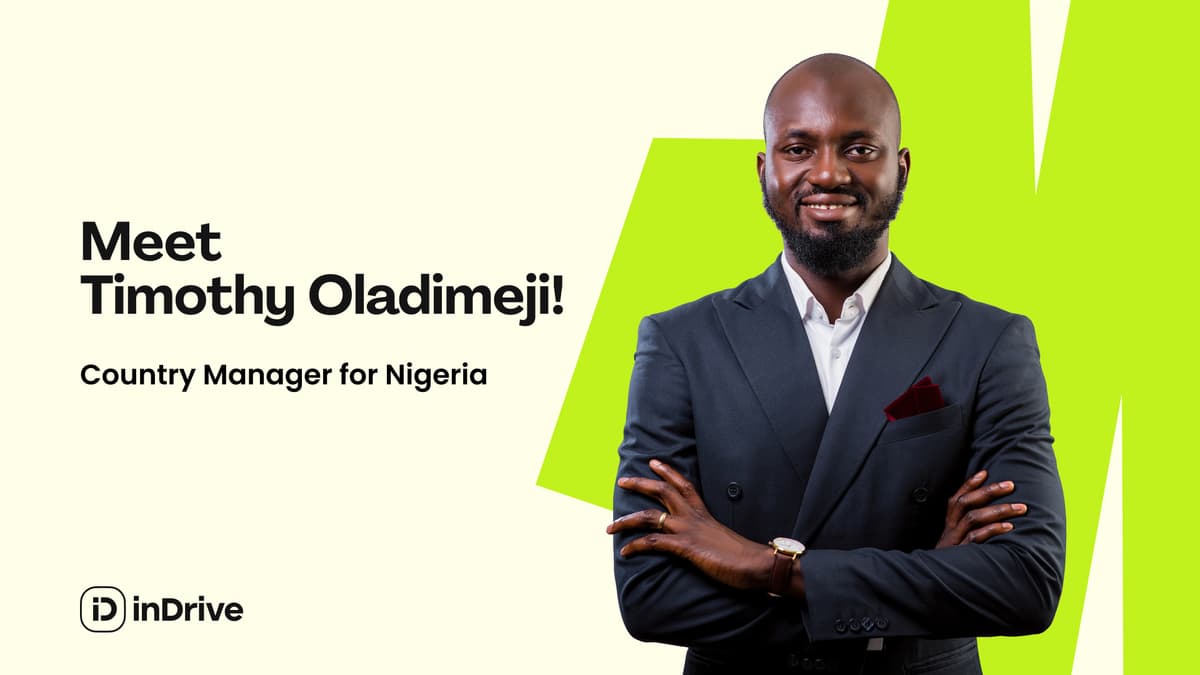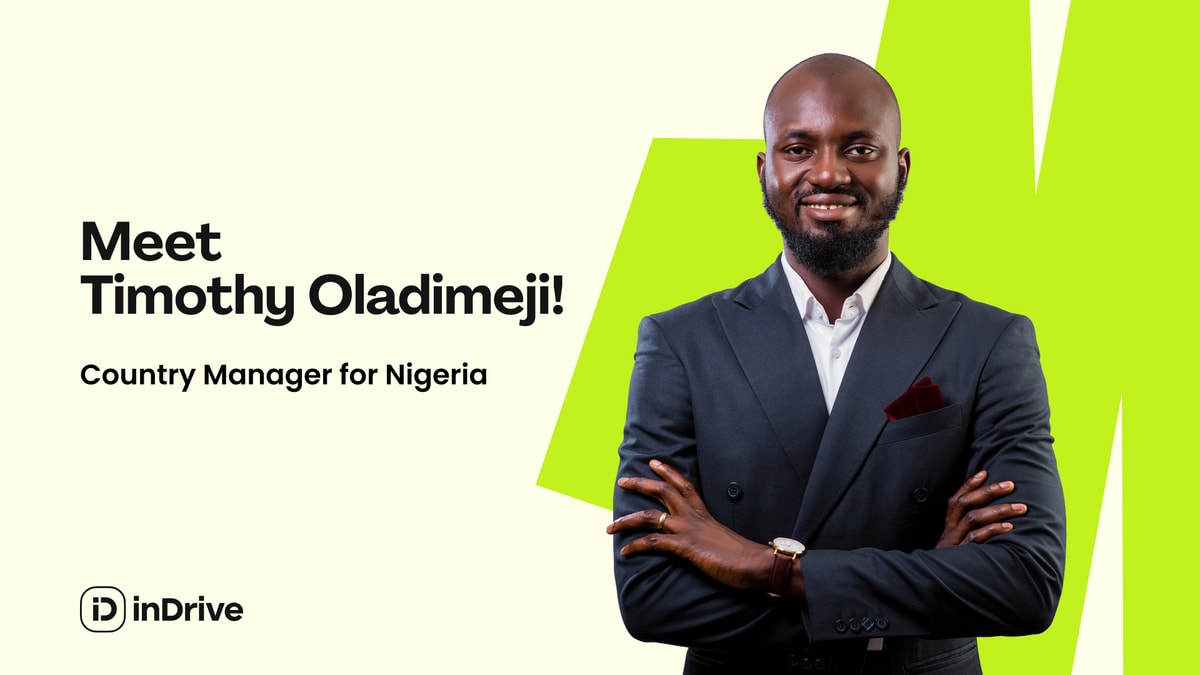
Timothy Oladimeji is inDrive’s Country Manager for Nigeria. He spoke to us about what differentiates this market from others, its challenges, opportunities – and repeatedly strong showing in the Aurora Tech Awards…
Tell us a bit about your local market.
Nigeria is the most populous black nation globally, with about 200 million people – so you would assume that spend on transport would be high. However, the urban population is roughly 35% of the country. In addition, the informal sector is the main employer of labor. SMEs employ well over 85% of the population, and this affects most people’s disposable income. We enjoy a pretty stable political environment; we are a resilient people.
Last year we were really pleased with the performance of our app, particularly ln Lagos, our most important market in the region, which contributes about 75% of our rides.
What differentiates inDrive from its competitors in Nigeria?
First, we have a very strong product, and product philosophy, i.e. choice, giving the people the opportunity to negotiate. Mobility or movement is the first characteristic of humanity; we should be able to move on our own terms. That choice, which is embedded in our product, is a key differentiating factor.
Nigeria has a very volatile market. At different instances where energy prices went up, people needed to be able to react, drivers especially. We were the only mobility company who gave that opportunity. The difference was evident in 2023 when there was an energy crisis – we saw how strong our product was. Subsequently, other companies have tried to launch the negotiating feature here but failed.
Transparency is another feature. For example, a passenger can see how many drivers are looking at their bid. And for drivers, previously, they didn't know up front where they were taking passengers, which could pose a security risk. However, as soon as we came to market, we showed key details including point A and point B, how many minutes the journey should take, how many kilometres, and so on. That transparency has changed the way the market operates: we’ve seen our competitors adopt similar features.
Efficiency is a key part of our DNA, and that also differentiates us.
New features or product you’re currently most excited about?
We’ve just launched comfort – we were able to do this because we built our geofence technology. That has been a game changer for us: it allows us to limit quadrants to certain geographical areas, so we could test without risking certain metrics. We didn't need a perfect situation nationally or across the whole of Lagos, we just identified the best places where the use cases were perfect and then deployed.
And because we have the geofence technology, we are able to launch a more affordable model – the tricycle. Government regulations mean that these can’t be used everywhere: they can't go on highways, they have to be in certain feeder systems, mostly for short distance trips between two kilometers to 5 km. So maybe within the neighborhood, when you need to get to the grocery store, to get power or go to the salon, then the tricycle is a good option. Now we have the geofence technology, so in July one of my key goals is to launch the tricycle in Abuja, Nigeria’s capital city.
Nigeria repeatedly does really well in the Aurora Tech Awards. Any comments?
It shows how resilient we are as a people. In a country that has a lot of problems, people want to provide solutions. I'm really proud that we deliver so many great women founders year after year.
And are you involved in the Awards in your capacity as Country Manager?
My primary job is to spotlight opportunities to founders, so when there is the open call I do as much as possible to provide intros to the tech community – venture capital firms, incubators, accelerators, etc. I facilitate sessions for founders … I'm learning that in a space of executive leadership, coaching others in the ecosystem is one of the ways you can contribute.
How does ride-hailing contribute to solving urban transport challenges in your country?
For every ride-hailing car on the road, you’re probably taking off 10 cars; so in a mega city like Lagos, which is projected to be the most populous city on Earth by around 2045, ride-hailing is essential. We have buses and waterways (we’re a coastal city), and in the past 2-3 years there’s been significant investment in rail lines, so our infrastructure is developing. Developing mass transport, multimodal transport would really help Lagos; but ride-hailing remains essential for the last mile and reducing the volume of vehicles. Especially for use cases like concerts!
What have you learnt since taking on the role of Country Manager?
If you want to make everyone happy, sell ice cream. As a manager, it’s your job to get things done; you need to project-manage – to check in, coach, and encourage the vision as closely as possible. That’s the new definition of success for me. If I give preference to one team mate, so as to seem inoffensive, I’m putting others who are doing their job 100% at risk, as well as the community we serve. You need to be firm for the greater good.
What would you most like to achieve?
To become number one in Nigeria - by far! Shaking up mobility, for example with the introduction of inDrive money and our super app, which could be a real game changer for us.
A book you think is worth reading?
The Bible and The Psychology of Money by Morgan Housel.
A movie everyone should see: The Godfather, and then 21. It’s a movie about a college student who wants to attend Harvard Medical school, and has to go to Vegas to gamble to pay his way.