Evgeny Kolotinsky, Head of Data Science at inDrive, recently contributed to a study by People Consulting, looking at the AI personnel most needed now – within inDrive and beyond. He shared his thoughts on the company’s approach to hiring and developing AI specialists, and what companies and governments can do to accelerate the development of such specialists. Here’s what he had to say:
Which AI competencies and roles does inDrive hire for and how easy are they to find?
For us, AI is an applied tool integrated into every key process, from helping passengers find drivers, to protecting users from fraud, and developing our Super App. As such, our most in-demand roles are at the intersection of engineering, data, and business. These include:
-
Data scientists with a focus on marketplace and pricing
We don't have fixed fares, which makes the tasks interesting, but also complex. You need to be able to work with demand elasticity, the "market" model, A/B experiments — and turn all this into live algorithms that affect real users. -
ML engineers who can take models to production
Training a model is only half the battle. Setting up pipelines, integrating them into a microservice, adding monitoring, tracking degradation and retraining — that's where you find the "bottleneck" in the market. Such specialists are rare, especially with MLOps experience. -
Data engineering and AI infrastructure support specialists (MLOps)
These are responsible for stable data pipelines, feature stores, automatic retraining, monitoring, and reliable delivery of models into production. Without them, AI doesn’t scale. -
NLP and LLM, especially for internal automation and support.
We’re actively implementing generative models to help with documentation, respond to requests, and navigate internal systems. This requires a combination of skills and competencies: a strong ML background, solid understanding of production, and pipeline building skills. -
Security Specialists.
This is primarily about ensuring the safety of people using the platform. We need specialists who can apply ML and automation to aspects like document recognition and validation, determining vehicle types, identifying risk scenarios, accelerating support work and request processing. It’s about embedding security directly into the product and operational processes.
When it comes to hiring, we mostly focus on middle and above levels, with only occasional junior hiring. Recently, it’s become simpler to recruit middle-level candidates, as the market has stabilized. At the same time, the search for senior and lead specialists (especially those with experience in production) is complicated by a global shortage of such personnel; for instance, in Kazakhstan, we compete with top companies from the US, Europe, and Asia.
The market for AI specialists is very active, but in terms of maturity, there is still potential for growth. We often meet people who are trained in courses; they know libraries, and how to launch models, but they don't yet know how to make this part of the product, how to launch an A/B test, how to track model degradation, how to interpret metrics, or how to evaluate impact on business.
It’s important to understand how the system works in the real world and under real loads, not just in a training example or on a limited data sample.
Overall, the AI/ML specialist is the most product-focused of the technical roles, and the most technical of the product roles. So an AI specialist can significantly influence business results, and their work extends beyond just training models.
Training and developing AI personnel
inDrive is taking two directions:
- Internal development. We don't just hire "ready-made" specialists; we create an environment where they can grow – through master classes, hackathons, internal challenges. Teams learn to set AI tasks, choose metrics, and test hypotheses. It’s important for us that AI becomes part of our everyday engineering culture.
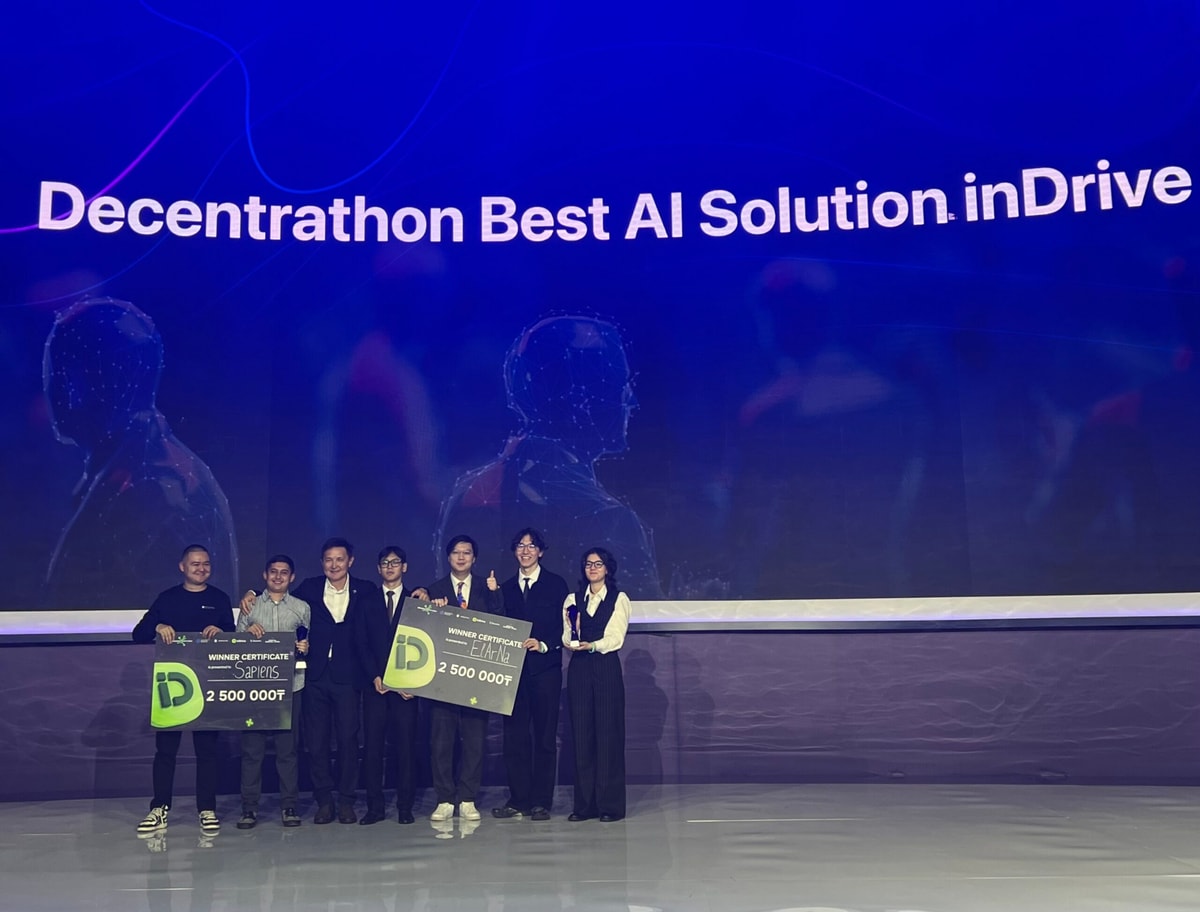
- Showing up as an AI company. We were exclusive partners for the AI track of Decentrathon 4.0, Kazakhstan’s largest offline hackathon, which covered 20 cities in the country and included more than 3 thousand young developers.
We also compensate for training and support growth (as part of our corporate bonuses). This has enabled some engineers from backend teams to transition to ML engineering.
Do companies need to accelerate the development of AI personnel? How?
Definitely. AI personnel are not just the future; they’re already needed for a competitive economy.
What businesses can do to accelerate their development:
- Grow people internally. Sometimes a backend engineer with good foundational knowledge becomes an ML engineer faster than a data science course graduate.
- Give real tasks and responsibility. Not "toy projects," but work with real data, SLAs, privacy, A/B.
- Collaborate with universities, through internships, joint courses, master-classes. This is an investment in the ecosystem.
What governments can do:
- Create "regulatory sandboxes" and clear guides, especially for high-risk systems — so that companies can experiment without fear of violations.
- Simplify access to infrastructure. Compute and data are the main bottlenecks.
- Focus on developing mid-to-senior personnel. Otherwise, the market will be "bottom-heavy" and unable to implement production solutions.
- And finally — international openness. Visas, grants, joint R&D. Personnel move where opportunities are more interesting, global, cutting-edge.
Ultimately, the companies that will come out ahead are those that treat AI development as an organizational priority, not just a hiring exercise.
For engineers and AI specialists looking for that kind of environment, inDrive offers scale and real responsibility – the decisions made here affect hundreds of millions of users in 48 countries across Latin America, Africa, and Asia. Teams stay small and autonomous; they own business outcomes rather than just executing tasks. This pushes engineers to grow in all directions: both technically and as decision-makers, team leads, and people accountable for the full result.
There's also the practical draw of building on the frontier: testing the latest AI agents, contributing to a unified AI platform, and shaping how automation gets applied to real-world problems at genuine scale.